How to Use the Table
- (A) HW Hull Time
Enter the published High Water time at Hull for the day. - (B) Time Correction
Apply the known correction for each lock (e.g. -1h 30m, +45m, etc.). - Adjusted Time (A ± B)
This gives the local tidal reference time for that lock. - Ebb / Flood Notes
- Identify whether you are travelling on:
- Flood tide (incoming)
- Ebb tide (outgoing)
- Note any lock-specific guidance (e.g. “leave 1 hour before HW”, “on start of ebb”).
- Identify whether you are travelling on:
Latest Safe Departure
- Based on navigation guidance, lock keeper advice, or pilot books.
Your Calculated Departure
- Final decision time after considering:
- Boat speed
- River conditions
- Safety margins
EXAMPLE
| Lock | HW Hull | Correction | Adjusted | Notes | Departure |
|---|---|---|---|---|---|
| Keadby | 14:00 | -1:30 | 12:30 | Leave at start of ebb | 12:15 |
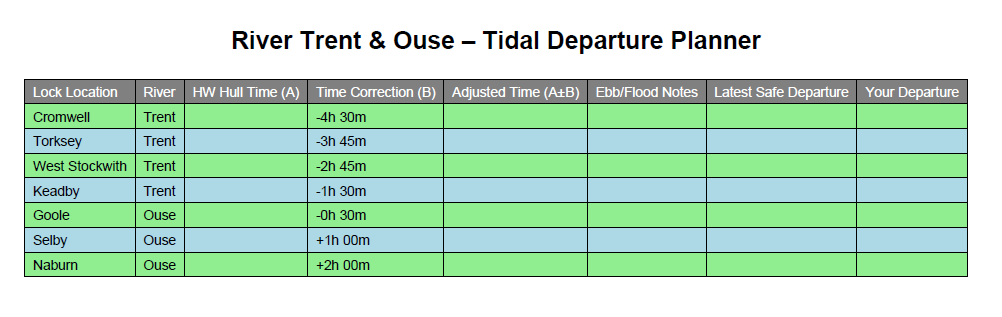
Full version available to download a printable version here
Key Notes (Important for Real Use)
1. Nature of These Corrections
Best departure windows typically begin.
These are rule-of-thumb pilotage values, not official tide tables.
They represent the time difference from Hull High Water when:
The tide turns, or
Best departure windows typically begin.
2. Ebb vs Flood Strategy
- Heading upstream (towards York / Naburn / Cromwell):
- Leave on the flood tide
- Aim to arrive before slack water or early ebb
- Heading downstream (towards Trent Falls / Humber):
- Leave just before or at High Water
- Ride the ebb tide down
3. Critical Sections
- Trent Falls (confluence) is highly tidal and timing-sensitive.
- Keadby ↔ West Stockwith is one of the most timing-critical stretches.
- Selby ↔ Naburn has a strong tidal push—don’t arrive late on ebb.
4. Always Confirm With:
- Lock keepers (especially Keadby, Cromwell, Naburn)
- VHF where applicable
- Updated navigation notices
Simple Working Example
- HW Hull: 14:00
- Keadby correction: -1h 30m
- Adjusted: 12:30
- Departure: ~12:00–12:30 (to catch ebb)